
Mind the Exponential Gap: A Systems-Level Reframing of AI-Driven Economic Transformation
Abstract
Prevailing analyses of artificial intelligence and its impact on labor markets rely heavily on linear, function-based models that evaluate disruption within isolated domains. These frameworks, while analytically convenient, fail to capture the systemic nature of current technological change. This paper introduces the concept of the Exponential Gap, defined as the widening divergence between the rate of technological capability advancement and the rate of human, institutional, and economic adaptation. By examining the convergence of cognitive automation, physical automation, real-time decision systems, and accelerating computational paradigms, this paper argues that contemporary disruption is neither sequential nor contained. Instead, it is simultaneous and structural. The implications extend beyond workforce displacement into the reconfiguration of organizational design, economic participation, and the role of human capability itself. This paper critiques dominant analytical models, proposes a multi-phase framework for the evolution of work, and outlines the conditions necessary to mitigate systemic instability arising from this gap.
1. Introduction: The Persistence of Incomplete Models
The rapid advancement of artificial intelligence has generated an extensive body of research attempting to quantify its impact on jobs, productivity, and economic structure. Institutions such as McKinsey Global Institute, the World Economic Forum, and Gartner have produced influential reports projecting workforce displacement alongside job creation, often concluding that while roles will change, overall economic equilibrium will be maintained through adaptation (McKinsey Global Institute, 2023; World Economic Forum, 2023).
Despite their analytical rigor, these models share a foundational limitation: they assume that disruption can be understood within bounded systems. The unit of analysis is typically a function, a role, or at most an industry. Even when acknowledging cross-sector implications, the underlying structure of these models remains linear. Automation displaces tasks, new roles emerge, and the labor market adjusts over time. This paradigm reflects historical patterns observed during prior industrial revolutions, where technological change, though transformative, unfolded across extended time horizons.
However, the current technological environment is characterized not by isolated innovation, but by convergence. Artificial intelligence is not acting alone. It is coupled with advances in robotics, distributed data systems, and computational scaling, creating a multi-layered transformation that cannot be adequately captured through function-level analysis. As a result, widely accepted frameworks risk underestimating both the speed and scope of disruption.
2. A Pattern Visible Across Five Industrial Eras
The current discourse surrounding artificial intelligence often treats disruption as a novel phenomenon, an unprecedented break from historical precedent. This framing is misleading. What is unfolding today is not an isolated event, but the latest phase in a long, observable pattern of technological acceleration and labor restructuring.
Across the past 250 years, each industrial revolution has introduced a new dominant form of production while simultaneously reducing the time required for society to adapt. The First Industrial Revolution unfolded over roughly eight decades, transitioning economies from manual production to mechanized manufacturing. The Second compressed this transition into approximately four decades, driven by electricity, steel, and mass production. The Third, defined by computing and digital systems, accelerated further. The Fourth introduced intelligent, connected systems and unfolded in roughly twenty years.
The Fifth Industrial Revolution, now underway, has emerged in less than a decade.
What distinguishes this progression is not simply the presence of innovation, but the compression of adaptation windows. Each successive era has required individuals, institutions, and labor markets to recalibrate more quickly than the one before it. The pattern is consistent: technological capability compounds, while human systems respond incrementally.
Historically, this gap has been manageable because transitions unfolded over generations. Today, they are unfolding within a single career span.
This shift transforms technological change from a cyclical adjustment into a structural condition. The current moment is not defined by the introduction of artificial intelligence alone, but by the culmination of an accelerating sequence that has reached a point where the pace of change itself has become the dominant variable.
3. The Limitations of Linear and Function-Based Analysis
A closer examination of contemporary research reveals a consistent methodological pattern: disruption is modeled as a series of localized adjustments. For example, analyses of customer service transformation often describe a reduction in frontline roles offset by increased demand for AI system management, training, and oversight. Similarly, studies of knowledge work emphasize augmentation, suggesting that AI enhances productivity while preserving the necessity of human roles (Brynjolfsson & McAfee, 2014).
While these conclusions are not incorrect in isolation, they are incomplete when generalized. The assumption that displaced labor is absorbed into adjacent roles depends on two conditions: first, that new roles emerge at a comparable rate to displacement; and second, that the skills required for these roles are attainable within existing adaptation mechanisms. Both assumptions become unstable under conditions of simultaneous multi-domain disruption.
The concept of “ripple effects,” frequently invoked in industry analyses, implies a contained propagation of change. Yet, when multiple foundational systems are undergoing transformation concurrently, the metaphor itself becomes misleading. Rather than ripples, the system experiences structural realignment. Changes in one domain do not propagate outward in a controlled manner; they intersect with parallel transformations, amplifying their combined impact.
4. Convergence of Disruptive Forces
To understand the inadequacy of current models, it is necessary to examine the convergence of four primary technological forces. The first is cognitive automation, driven by advances in machine learning and generative AI. These systems are increasingly capable of performing tasks traditionally associated with human reasoning, including analysis, communication, and decision support (Acemoglu & Restrepo, 2020).
The second is physical automation, enabled by robotics and autonomous systems. While historically constrained to structured environments such as manufacturing, robotics is expanding into logistics, construction, and service domains. The integration of AI with physical systems extends automation beyond digital processes into the material world.
The third force is the emergence of real-time, data-driven decision systems. Organizations are transitioning from hierarchical information flows, where data is collected, interpreted, and escalated, to environments where insights are generated and acted upon instantaneously. This shift reduces the need for intermediary roles whose primary function is to translate information across organizational layers.
The fourth force is computational acceleration. Advances in hardware, cloud infrastructure, and the early development of quantum computing are compressing development cycles and enabling the rapid scaling of complex systems. While quantum computing remains emergent, its potential to solve optimization and simulation problems at unprecedented speeds suggests a future where technological advancement accelerates even further.
These forces do not operate independently. Their interaction produces a compounded effect, altering not only individual roles but the structure of entire systems. The result is a form of disruption that is both horizontal, spanning industries, and vertical, collapsing layers within organizations.
5. Industrial Compression and the Mathematics of Acceleration
The concept of the Exponential Gap becomes materially observable when examining the duration of industrial transitions over time.
The First Industrial Revolution spanned approximately 80 years. The Second lasted roughly 44 years. The Third compressed to around 30 years. The Fourth emerged and matured within approximately 20 years. The current phase, driven by artificial intelligence and converging technologies, has reached global impact in less than 10 years.
This is not a linear reduction. It is a compounding pattern.
When plotted, the intervals between paradigm shifts form a downward curve, reflecting an exponential decrease in the time required for transformative technologies to move from emergence to systemic impact. As these intervals shrink, the capacity for societies to absorb disruption without friction diminishes.
This compression has two critical implications.
First, adaptation is no longer generational. Workers are now required to upskill multiple times within a single career, often in response to technologies that did not exist at the start of that career.
Second, institutions designed for stability, education systems, corporate structures, and policy frameworks, are increasingly misaligned with the rate of change. These systems were built for linear progression, not exponential acceleration.
The Exponential Gap is therefore not theoretical. It is the measurable distance created by the compression of time between technological revolutions and the comparatively fixed rate of human adaptation. As illustrated in Figure 1, the duration between industrial paradigms follows a clear exponential compression curve, reinforcing the structural nature of the Exponential Gap
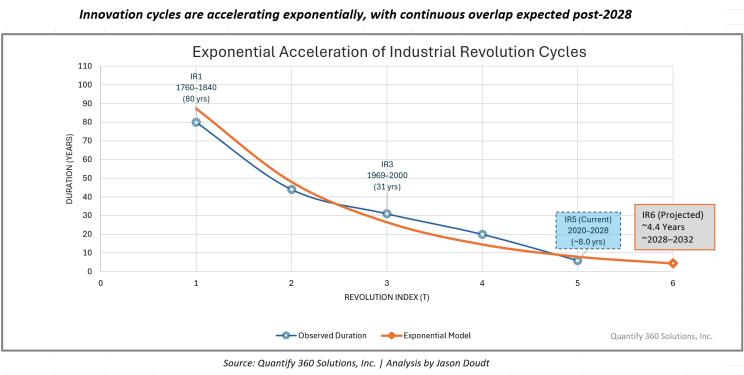
Figure 1. Exponential Acceleration of Industrial Revolution Cycles
Innovation cycles are compressing at an exponential rate, reducing the time between paradigm shifts and widening the gap between technological advancement and human adaptation.
Note: Observed durations for IR1–IR5 are based on historical analysis (≈80, 44, 31, 20, and 6+ years). The exponential model and IR6 projection are analytical constructs used to illustrate the compression trend and the expanding Exponential Gap.
6. The Evolution of Work: A Multi-Phase Framework
Within this context, the evolution of work can be understood as a progression through three distinct but overlapping phases. The first phase is characterized by augmentation. AI tools increase the productivity of individual workers, enabling organizations to achieve greater output without proportional increases in headcount. This phase is already observable across multiple sectors, where automation reduces the need for routine tasks while enhancing the capabilities of remaining employees.
The second phase involves orchestration. As systems become more complex, human roles shift toward managing interactions between automated processes. Workers are no longer defined by the tasks they perform, but by their ability to oversee and coordinate systems. This transition introduces a critical dependency on continuous learning, as the skills required for orchestration differ fundamentally from those associated with execution.
The third phase is autonomy. In this stage, systems operate with minimal human intervention, handling not only routine tasks but also adaptive decision-making. The role of human labor becomes increasingly peripheral, focused on governance, exception handling, and strategic direction. Importantly, this phase challenges the assumption that all displaced roles will be replaced by new forms of employment. Instead, it raises the possibility that certain categories of work may diminish without direct substitution.
The progression from augmentation to orchestration to autonomy is not simply a technological sequence. It is also a social and organizational sequence. In the earliest phase, labor remains central, but its productivity becomes increasingly dependent on digital assistance. In the middle phase, value begins to shift away from execution and toward supervision, coordination, and systems fluency. In the final phase, human involvement narrows toward judgment, governance, accountability, and edge-case intervention. What appears on the surface to be a story of productivity gains is, at a deeper level, a reallocation of human economic purpose.
This matters because labor market analysis often assumes continuity where discontinuity is emerging. The worker whose role is “augmented” today may discover that the same workflow, once orchestrated more efficiently, becomes partially or mostly autonomous tomorrow. The transitions are not neatly separated in time. In many organizations, they are occurring simultaneously across departments, functions, and layers of the enterprise. This overlapping progression intensifies uncertainty for workers and leadership alike, because the endpoint is rarely visible while the transformation is already underway.
For this reason, the multi-phase framework is useful not only as a descriptive model, but as a forecasting tool. It helps explain why so many organizations underestimate the long-term implications of tools they initially adopt for narrow efficiency gains. A workflow enhancement at the point of entry can become a labor redesign at the point of maturity. Once that is understood, the question is no longer whether AI changes jobs, but how quickly entire categories of work evolve from human-led processes into machine-mediated systems.
7. The Migration of Displacement Up the Skill Ladder
One of the most overlooked dynamics in current AI discourse is not the presence of job displacement, but the direction in which that displacement is moving.
During the First and Second Industrial Revolutions, technology primarily replaced physical labor. Mechanization reduced the need for manual production, while mass production eliminated many forms of skilled craftsmanship. Displacement occurred at the level of muscle and repetitive manual work.
The Third Industrial Revolution extended this impact into routine cognitive tasks. Clerical roles, administrative functions, and basic information processing began to be automated. This period marked the beginning of white-collar disruption, though it remained largely confined to structured, repeatable tasks.
The current phase represents a fundamental escalation.
Artificial intelligence is now capable of performing non-routine cognitive work. Tasks involving analysis, communication, synthesis, and even elements of creativity are increasingly within the capability of machine systems. This shifts the target of disruption toward roles historically considered insulated from automation, including professional, technical, and knowledge-based occupations.
This migration has profound implications.
First, it challenges the long-standing assumption that education alone provides insulation from technological disruption. Advanced degrees and specialized training no longer guarantee stability in the same way they did in previous eras.
Second, it alters the structure of opportunity within the labor market. Rather than a simple replacement of low-skill roles with higher-skill roles, the system is undergoing a reconfiguration where entire categories of work are being redefined simultaneously.
This is not a continuation of previous patterns. It is an expansion of them into domains that were previously considered uniquely human.
The significance of this shift cannot be overstated. Earlier waves of automation displaced labor in visible sectors such as agriculture, textiles, and manufacturing. Later waves digitized clerical work and reduced routine back-office functions. But the present wave is moving into the architecture of professional judgment itself. Legal research, technical drafting, financial analysis, software generation, medical documentation, marketing strategy, and customer communication are all being altered by systems that can generate, interpret, summarize, recommend, and iterate at speed.
This does not mean that entire professions disappear overnight. It does mean that the internal composition of those professions is changing. Tasks once considered foundational to skill development or early-career advancement may be delegated to machine systems before workers have had time to master them. That creates a second-order effect: not only are jobs exposed, but the developmental pathways into expertise may also begin to erode. If entry-level analytical tasks disappear or contract significantly, the ladder into senior, strategic, or specialized roles becomes less stable.
In this sense, the migration of displacement up the skill ladder is not just a labor market issue. It is also a capability formation issue. Societies do not simply need workers who can use advanced tools; they also need future experts, leaders, and professionals who have developed the judgment that comes from experience. If the bottom rungs of knowledge work are increasingly automated, institutions will need to rethink how skill, competence, and professional maturity are built in the first place.
8. The Exponential Gap: Definition and Implications
The convergence of these forces and the progression of work through these phases give rise to a structural imbalance. Technological capability is advancing at an exponential rate, driven by compounding innovation and computational scaling. In contrast, human adaptation, whether through education, upskilling, or institutional reform, remains largely linear.
This divergence constitutes the Exponential Gap. It is not merely a temporal lag, but a widening distance between two fundamentally different rates of change. The implications of this gap are profound. Organizations can adopt new technologies faster than their workforce can adapt, leading to mismatches between capability and capacity. Educational systems, designed around static curricula, struggle to prepare individuals for dynamic skill requirements. Policy frameworks, constrained by political and bureaucratic processes, lag behind technological realities.
The Exponential Gap also introduces systemic risk. As the gap widens, the potential for large-scale economic displacement increases. Traditional mechanisms for absorbing displaced labor, such as job creation in emerging sectors, may be insufficient if the pace of displacement exceeds the rate of adaptation.
The concept is especially important because it reorients the discussion away from simplistic binaries. The question is not whether technology is good or bad for society. Nor is it whether some new jobs will eventually emerge. Historically, new forms of work have indeed followed prior waves of technological change. The deeper question is whether the speed of institutional response can remain within a tolerable range relative to the speed of technological acceleration. When the answer is no, social strain begins to accumulate long before long-term equilibrium arrives.
That strain can take many forms. It may appear as labor market volatility, political polarization, wage divergence, regional inequality, or widespread anxiety surrounding relevance and security. It may also appear inside firms as leadership confusion, workforce fatigue, cultural fragmentation, and failed digital transformation efforts. The Exponential Gap therefore describes not only a macroeconomic pattern, but also an organizational and human one. It is as visible in enterprise restructuring and upskilling bottlenecks as it is in labor statistics.
Importantly, the gap is widened not only by accelerating technology, but also by the relative inertia of the systems expected to absorb its effects. Education reform is slow. Corporate redesign is often reactive. Public policy lags behind both. Families, communities, and social norms evolve more slowly still. This means the gap is not merely about the speed of tools. It is about the friction created when one layer of civilization begins moving exponentially while the others remain calibrated to linear time.
9. Human Readiness as the Primary Constraint
While much of the discourse surrounding AI focuses on technological risk, the more immediate constraint lies in human readiness. Participation in an increasingly automated economy requires not only access to technology but the capacity to engage with it effectively. This capacity is shaped by factors including education, mindset, and the ability to adapt to continuous change.
A critical implication of the Exponential Gap is the emergence of a new form of inequality. This inequality is not solely based on access to resources, but on the ability to remain relevant within rapidly evolving systems. Individuals who can adapt to new tools and paradigms are positioned to benefit from increased productivity and new opportunities. Those who cannot may find themselves excluded from meaningful economic participation.
This dynamic is further complicated by existing institutional structures. Many systems, including aspects of education and social support, are not optimized for rapid adaptation. In some cases, they may inadvertently reinforce static skill sets, exacerbating the gap between technological capability and human readiness.
Human readiness is often discussed as if it were primarily a matter of training. Training matters, but it is insufficient on its own. Readiness is also psychological, organizational, and cultural. It includes the willingness to rethink professional identity, the confidence to operate in environments of continual uncertainty, and the discipline to learn iteratively rather than episodically. These are not qualities most institutions have historically cultivated at scale, because most institutions were built around the expectation of relative stability.
This is why the challenge of adaptation is deeper than many policy discussions acknowledge. It is not enough to tell workers to upskill if the pace of change keeps redefining which skills matter. Nor is it enough to provide technical access if people are not prepared to interpret, challenge, govern, and collaborate with advanced systems. The constraint is not simply whether people can use the tools. It is whether they can evolve as fast as the systems surrounding them.
Once viewed through this lens, human readiness becomes central to economic resilience. The most valuable workers, teams, and institutions may not be those with the most static expertise, but those with the highest adaptive capacity. This shifts the emphasis from credential accumulation alone to resilience, learning velocity, systems thinking, and human judgment. In the long run, these may prove to be the qualities that determine who remains economically relevant in an era defined by exponential change.
10. Emerging Economic Structures Beyond Traditional Employment
Focusing exclusively on job displacement obscures a broader transformation. As technological systems evolve, new domains of economic activity are emerging that do not align with traditional employment models. Advances in energy, materials science, and digital infrastructure are creating opportunities for entirely new forms of value creation.
The concept of Industry 6.0, though still developing, points toward an economy characterized by fully integrated digital and physical systems, quantum-enabled capabilities, and expanded operational domains, including space-based industries. These developments suggest that future economic growth may occur in areas that are currently inaccessible or only partially understood.
However, the existence of new opportunities does not guarantee broad participation. The benefits of these emerging domains will depend on the ability of individuals and institutions to adapt. Without mechanisms to bridge the Exponential Gap, there is a risk that new forms of value creation will be concentrated among a limited subset of actors.
This possibility raises a serious strategic question. If much of the future economy is built around platforms, ecosystems, autonomous systems, synthetic intelligence, advanced infrastructure, and machine-mediated production, then traditional employment may no longer serve as the sole or even primary mechanism for distributing economic participation. In such an environment, societies may be forced to confront questions about ownership, access, contribution, and value in ways that existing labor models were never designed to answer.
There is historical precedent for technology creating entirely new sectors that were previously unimaginable. Yet the scale and coordination demands of emerging domains suggest that future growth may be structurally different from the service-economy expansions that characterized earlier transitions. The combination of intelligent systems, resilient infrastructure, distributed computation, and high-capital ecosystems may favor organizations and individuals already positioned to capture nonlinear returns. That creates the risk that the rewards of innovation become even more concentrated than in previous eras.
For this reason, the future of work cannot be discussed apart from the future of economic architecture. The challenge is not only helping workers move from one job category to another. It is ensuring that the next economic order remains socially legible and broadly participatory. If the labor market is transformed but the underlying structures of access, education, ownership, and adaptability are not, then even a highly innovative economy may become increasingly exclusionary.
11. Observed Early Signals of the Exponential Gap
While much of the discussion surrounding artificial intelligence remains forward-looking, early indicators suggest that the Exponential Gap is already manifesting within the labor market.
Recent data shows that roles requiring higher levels of education are among the most exposed to AI-driven transformation. Workers with advanced degrees are disproportionately represented in occupations where generative AI can augment or replace core tasks. This marks a reversal from earlier automation waves, which primarily affected lower-skilled labor.
At the same time, organizations are placing a measurable premium on AI-related skills, with wage differentials emerging for individuals capable of effectively leveraging these tools. This creates a divergence between those who can integrate into AI-augmented workflows and those who cannot.
There are also emerging demographic signals. Early evidence indicates a slowdown in hiring among younger workers entering highly exposed occupations, suggesting that entry-level pathways into certain professions are beginning to contract. Additionally, roles traditionally concentrated among female workers, particularly in administrative and support functions, are showing higher levels of exposure to automation.
Individually, these signals may appear incremental. Collectively, they point toward a structural shift.
The Exponential Gap is not a future condition. It is already forming, visible in the misalignment between technological capability and labor market absorption.
These early signals matter because they reveal that the current transformation is not confined to speculative forecasts. It is already shaping hiring behavior, compensation patterns, and occupational exposure in measurable ways. That should alter the tone of the policy and leadership response. Discussions that treat AI disruption as a distant horizon risk lagging behind a process that is already underway inside firms, labor markets, and professional pathways.
The concentration of exposure among highly educated workers is especially significant. For decades, the dominant social narrative held that increasing education was the primary defense against automation and economic precarity. While education remains essential, the emerging evidence suggests that the relationship is more complicated. In the age of generative AI, many of the tasks most exposed to automation are precisely those associated with formal knowledge work. This does not negate the value of education, but it does challenge the assumption that credentials alone guarantee insulation.
The same is true of wage premiums for AI skills. These premiums are signals of opportunity, but they are also signals of divergence. Workers who can effectively integrate machine systems into their workflows may capture outsized returns, while those who cannot may experience relative stagnation. Over time, this can create a new segmentation of the workforce, one defined less by traditional occupation categories and more by proximity to technologically amplified productivity.
The slowdown in entry-level hiring and the disproportionate exposure of many female-dominated occupational categories deepen the concern. These are not peripheral issues. They point to the possibility that AI may alter not only job content, but also career entry, progression, and demographic equity. If entry pathways narrow while mid- and upper-tier work is simultaneously redefined, then the resulting labor market may become more volatile, less predictable, and more difficult to navigate for entire cohorts of workers.
12. The Timing Paradox: Job Creation vs. Job Displacement
One of the most widely cited narratives in the current discourse on artificial intelligence and the future of work is the expectation of net positive job creation. Data from the World Economic Forum and McKinsey suggests that while AI could displace up to 85 million jobs globally by 2030, it may simultaneously create approximately 97 million new roles, resulting in a net gain of roughly 12 million positions (World Economic Forum, 2023; McKinsey Global Institute, 2023).
At a surface level, this projection appears reassuring. It reinforces a familiar historical pattern in which technological disruption is ultimately offset by the emergence of new forms of work. However, this interpretation obscures a critical structural risk: the assumption of simultaneity.
The underlying models imply that job creation and job displacement occur in parallel, allowing labor markets to rebalance in real time. This assumption is not supported by the dynamics described throughout this paper.
Technological adoption does not occur uniformly, nor does it produce immediate downstream economic expansion. In practice, organizations implement automation to increase efficiency, reduce cost, and optimize output. The immediate effect is a reduction in labor demand within existing structures. The creation of entirely new industries, markets, and job categories historically lags behind these efficiency gains.
This introduces what can be described as a timing paradox.
If 85 million roles are displaced before the 97 million new roles fully materialize, the result is not a net positive transition, but a period of significant economic contraction for affected workers. The sequence of disruption matters as much as the aggregate outcome.
The current phase of technological development is particularly susceptible to this imbalance. Artificial intelligence, unlike many previous technologies, is not only creating new capabilities but also enabling organizations to operate with fewer people across multiple layers simultaneously. Tasks involving data aggregation, reporting, analysis, and even decision support, functions that have historically justified entire tiers of management and coordination, are increasingly being absorbed by automated systems.
This has direct implications for organizational structure. Many roles that exist primarily to collect, interpret, and transmit information across hierarchical levels may become redundant in environments where data is continuously processed and surfaced in real time. As a result, companies may experience a compression of organizational layers, particularly within middle management and administrative functions.
The consequence is not merely job displacement at the margins, but the potential elimination of entire career pathways.
This distinction is critical. In previous industrial transitions, displaced workers could often move into adjacent roles within the same or related industries. In the current environment, the removal of foundational tasks may limit the availability of entry and mid-level roles that traditionally served as stepping stones to more advanced positions.
The risk is therefore not only that jobs disappear, but that the mechanisms for workforce re-entry and progression become constrained.
This challenge is further compounded by the economic realities faced by most workers. In many developed economies, a significant portion of the population lacks sufficient savings to sustain prolonged periods without income. In the United States, for example, a large percentage of households would struggle to cover even twelve months of expenses without employment.
If displacement outpaces job creation by even a few years, the resulting gap could produce widespread financial instability.
Under such conditions, the consequences extend beyond economics. Prolonged unemployment at scale has historically been associated with increased social tension, political instability, and erosion of institutional trust. While it would be speculative to predict specific outcomes, it is reasonable to assert that a rapid and uneven transition of this magnitude carries the potential for significant societal disruption.
This possibility raises an urgent set of questions for business leaders, policymakers, and institutions:
- What mechanisms exist to support workers during multi-year transitions between roles or industries?
- How should organizations balance efficiency gains from automation with broader economic stability?
- What responsibility do firms have to their workforce when technological adoption eliminates the need for existing roles?
- How can governments incentivize workforce retention, upskilling, and redeployment at scale?
One potential approach is the introduction of targeted economic incentives designed to preserve employment during periods of transition. For example, governments could explore tax credit structures that offset the cost of retaining employees whose roles are being transformed by automation. Under such a model, organizations would be encouraged to keep workers employed while investing in upskilling and redeployment efforts, rather than immediately reducing headcount.
This approach reframes workforce retention not as a cost burden, but as a shared investment in economic stability.
Importantly, the scale of the challenge should not be underestimated. The widely cited figure of 85 million displaced roles represents an estimate based on current models. The actual impact could be higher, particularly if adoption accelerates or expands into domains not fully accounted for in existing analyses.
The capabilities of current AI systems already extend across a wide range of functions. The degree to which these capabilities are implemented is not constrained by technology alone, but by organizational willingness to adopt them.
This suggests that the upper bound of potential disruption remains uncertain.
Within this context, the expectation that new job creation will fully offset displacement within the same timeframe appears increasingly optimistic. While new industries and economic domains will likely emerge, they may do so on a timeline more consistent with what this paper defines as the next industrial phase.
If that is the case, then a significant portion of job creation may occur not within the current transition, but in the early stages of what could be considered Industry 6.0.
This reinforces the central argument of the Exponential Gap. The issue is not whether new opportunities will exist, but whether they will emerge quickly enough to absorb those displaced by accelerating technological capability.
The timing of that transition may prove to be one of the most consequential variables in determining the stability of the global economy over the coming decades.
13. Conclusion: Reframing the Problem
The dominant narrative surrounding AI and the future of work is insufficient not because it is incorrect, but because it is incomplete. By focusing on isolated functions and linear adaptation, existing models fail to account for the systemic nature of current technological change.
The Exponential Gap provides a framework for understanding this disconnect. It shifts the focus from individual technologies to the relationship between technological advancement and human adaptation. It highlights the need to consider not only what technology can do, but whether individuals, organizations, and institutions can evolve at a comparable rate.
Addressing this gap will require coordinated effort across multiple domains. Individuals must embrace continuous learning, organizations must balance efficiency with workforce development, and governance structures must evolve to support rapid innovation. Most critically, education systems must transition from static knowledge delivery to dynamic skill development.
The challenge ahead is not simply to manage disruption, but to align the pace of human adaptation with the trajectory of technological progress. Failure to do so will not halt innovation, but it will determine who is able to participate in its outcomes. If the Exponential Gap defines the rate of change, the Timing Paradox defines the risk of misalignment between displacement and opportunity. If this paper is correct, then the central issue of the coming era is not whether artificial intelligence will change the economy. It already is. The more consequential issue is whether human systems can be redesigned quickly enough to remain coherent under the pressure of exponential change. That is a leadership question, an institutional question, an educational question, and ultimately a civilizational one.
For business leaders, this means technological adoption can no longer be separated from workforce design, cultural resilience, and governance capability. For policymakers, it means labor market support must evolve beyond reactive safety nets toward anticipatory adaptation systems. For educators, it means preparing individuals not only for a first job, but for repeated reinvention across a lifetime. And for society at large, it means confronting the possibility that the future will reward adaptability, judgment, and systems fluency more than static expertise alone.
The Exponential Gap is therefore not simply a concept for understanding technological acceleration. It is a framework for recognizing the real source of instability in the present moment. The threat is not innovation itself. The threat is the widening distance between what our technologies can do and what our human systems are prepared to absorb. Closing that distance may become one of the defining challenges of this century.
AI DISCLOSURE
This article was developed with the assistance of AI tools, including ChatGPT (v5.4) and Gemini (Deep Research), as research and editing support. The intellectual framework, the Exponential Gap concept, and the positions expressed are the author’s own, developed through professional experience, academic work, and ongoing research. AI contributed structural editing, research synthesis, and source identification. Supporting perspectives from referenced authors and institutions informed elements of the discussion; however, the synthesis, interpretation, and overall framework presented are original.
References
- Acemoglu, D., & Johnson, S. (2024). Learning from Ricardo and Thompson: Machinery and labor in the early industrial revolution and in the age of AI. Massachusetts Institute of Technology. https://shapingwork.mit.edu/wp-content/uploads/2024/04/Acemoglu_Johnson_April-2024.pdf
- Acemoglu, D., & Restrepo, P. (2020). Artificial intelligence, automation, and work. Journal of Economic Perspectives, 34(1), 3–30.
- Anthropic. (2025). Labor market impacts of AI: A new measure and early evidence. https://www.anthropic.com/research/labor-market-impacts
- Autor, D. H. (2015). Why are there still so many jobs? The history and future of workplace automation. Journal of Economic Perspectives, 29(3), 3–30.
- Bresnahan, T. F., & Trajtenberg, M. (1995). General purpose technologies: Engines of growth? Journal of Econometrics, 65(1), 83–108.
- Brynjolfsson, E., & McAfee, A. (2014). The second machine age: Work, progress, and prosperity in a time of brilliant technologies. W. W. Norton & Company.
- Chicago Federal Reserve. (2024). Occupational switching during the Second Industrial Revolution. Federal Reserve Bank of Chicago. https://www.chicagofed.org/-/media/publications/working-papers/2024/wp2024-01.pdf
- McKinsey Global Institute. (2023). Generative AI and the future of work in America. McKinsey & Company.
- Mokyr, J. (1998). The Second Industrial Revolution, 1870–1914. Northwestern University. https://sites.northwestern.edu/jmokyr/files/2016/06/The-Second-Industrial-Revolution-1870-1914-Aug-1998-1ubah7s.pdf
- World Economic Forum. (2016). The future of jobs: Employment, skills and workforce strategy for the Fourth Industrial Revolution. World Economic Forum.
- World Economic Forum. (2023). The future of jobs report 2023. World Economic Forum.
- International Labour Organization. (2024). Generative AI and jobs: A global analysis of potential effects on job quantity and quality. International Labour Office.